dir
Baseline
Widely available
*
This feature is well established and works across many devices and browser versions. It’s been available across browsers since January 2023.
* Some parts of this feature may have varying levels of support.
The dir global attribute is an enumerated attribute that indicates the directionality of the MathML element.
Syntax
<math dir="ltr">
<math dir="rtl">
Values
Description
The directionality controls whether math formulas are rendered left-to-right or right-to-left.
Mirroring and stretching MathML formulas in RTL mode
When rendering a written language that displayed right-to-left, the symbols in a MathML formula may need to be mirrored/flipped around the vertical axis, and potentially also stretched vertically.
Mirroring may be achieved using different approaches to find a "base glyph":
- Character-level mirroring: replacing a character with the equivalent mirrored Unicode code point as defined by Unicode's
Bidi_Mirroredproperty (for example, replacing>with<, or]with[). - Glyph-level mirroring: replacing a character with a glyph that can represent it in a mirrored content (if no direct replacement exists).
This requires that the font used supports the Right to left mirror forms (
rtlm) font feature.
The base glyph may then be used as a key in the OpenType MathVariant table to get either a larger glyph or a glyph assembly.
Note that effective mirroring and stretching requires a font that includes both a OpenType MathVariant table and support for the rtlm font feature, such as XITS.
Prefer dir to the CSS direction property
This attribute can be overridden by the direction CSS property, if a CSS page is active and the element supports these properties.
As the directionality of mathematics is semantically related to its content and not to its presentation, it is recommended that web developers use this attribute instead of the related CSS properties when possible.
That way, the formulas will display correctly even on a browser that doesn't support CSS or has the CSS deactivated.
Note:
The dir attribute is often set to rtl in the Arabic-speaking world.
However, languages written from right to left often embed mathematical content written from left to right.
Consequently, the auto keyword from the HTML dir attribute is not recognized and by default the user agent stylesheet resets the direction property on the math element.
Examples
Basic usage
<!-- Moroccan style -->
<math display="block" dir="ltr">
  <msqrt>
    <mi>س</mi>
  </msqrt>
  <mo>=</mo>
  <msup>
    <mn>3</mn>
    <mi>ب</mi>
  </msup>
</math>

<!-- Maghreb/Machrek style -->
<math display="block" dir="rtl">
  <msqrt>
    <mi>س</mi>
  </msqrt>
  <mo>=</mo>
  <msup>
    <mn>٣</mn>
    <mi>ب</mi>
  </msup>
</math>
Mirroring and stretching
This example demonstrates the effects of ltr and rtl direction for a more complicated MathML formula, including the effects of setting largeop and stretchy on the <mo> element.
MathML
First we link a stylesheet for the XITS font, which supports the rtlm font feature and MathVariant table needed to properly mirror and stretch glyphs.
<link
  rel="stylesheet"
  href="https://fred-wang.github.io/MathFonts/XITS/mathfonts.css" />
The first two formulas set largeop and stretchy to false for the respective elements, and are displayed ltr and rtl.
<math dir="ltr" display="block">
  <mrow>
    <munderover>
      <mo largeop="false">∑</mo>
      <mrow>
        <mi>n</mi>
        <mo>=</mo>
        <mn>1</mn>
      </mrow>
      <mn>∞</mn>
    </munderover>
    <mfrac>
      <mn>1</mn>
      <msup>
        <mi>n</mi>
        <mn>2</mn>
      </msup>
    </mfrac>
  </mrow>
  <mo>∊</mo>
  <mrow>
    <mo stretchy="false">(</mo>
    <mfrac>
      <mn>3</mn>
      <mn>2</mn>
    </mfrac>
    <mo>,</mo>
    <mfrac>
      <mn>7</mn>
      <mn>4</mn>
    </mfrac>
    <mo stretchy="false">]</mo>
  </mrow>
</math>
<math dir="rtl" display="block">
  <mrow>
    <munderover>
      <mo largeop="false">∑</mo>
      <mrow>
        <mi>n</mi>
        <mo>=</mo>
        <mn>1</mn>
      </mrow>
      <mn>∞</mn>
    </munderover>
    <mfrac>
      <mn>1</mn>
      <msup>
        <mi>n</mi>
        <mn>2</mn>
      </msup>
    </mfrac>
  </mrow>
  <mo>∊</mo>
  <mrow>
    <mo stretchy="false">(</mo>
    <mfrac>
      <mn>3</mn>
      <mn>2</mn>
    </mfrac>
    <mo>,</mo>
    <mfrac>
      <mn>7</mn>
      <mn>4</mn>
    </mfrac>
    <mo stretchy="false">]</mo>
  </mrow>
</math>
This formula is also rtl, but sets largeop to true for the ∑ operator, which renders it larger.
It also sets stretchy to true for the braces, which makes them stretch to the height of the contained fraction on supporting browsers.
<math dir="rtl" display="block">
  <mrow>
    <munderover>
      <mo largeop="true">∑</mo>
      <mrow>
        <mi>n</mi>
        <mo>=</mo>
        <mn>1</mn>
      </mrow>
      <mn>∞</mn>
    </munderover>
    <mfrac>
      <mn>1</mn>
      <msup>
        <mi>n</mi>
        <mn>2</mn>
      </msup>
    </mfrac>
  </mrow>
  <mo>∊</mo>
  <mrow>
    <mo stretchy="true">(</mo>
    <mfrac>
      <mn>3</mn>
      <mn>2</mn>
    </mfrac>
    <mo>,</mo>
    <mfrac>
      <mn>7</mn>
      <mn>4</mn>
    </mfrac>
    <mo stretchy="true">]</mo>
  </mrow>
</math>
Results
On a browser that supports RTL mirroring and stretching the output for the three formulas should appear as shown below.
The first two show the formula left-to-right, and right-to-left without any stretching.
The final formula uses rtl with stretching, and largeop for the sum symbol.
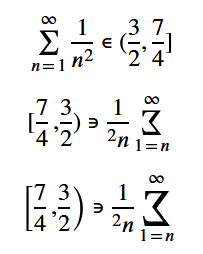
On this browser, it looks like this:
Specifications
| Specification |
|---|
| MathML Core # dfn-dir |
Browser compatibility
See also
- All global attributes.
direction- The HTML
dirglobal attribute